
On November 11th, the Research Master’s students in Environmental Humanities visited Four Siblings as part of the seminar Staying With the Trouble: Environmental Activism, taught by Dr. Kyveli Mavrokordopoulou. What follows is a reflection by two students, Jelmer Groenenboom and Veronica Rossi, on the wide range of topics discussed during the class; from situated approaches to gardening to strategies for combating plant blindness.
On a crisp and now-and-then sunny day, we were welcomed at the Four Siblings collective in Amsterdam, a self-described ‘queer-eco-feminist art project and community garden’ run by artists Müge Yılmaz, Emiel Wolf and Clara Arámburo, to get a taste of how artists confront food-related questions in the Netherlands, where immense quantities of food are produced, while organic food remains inaccessible and expensive and pollutants such as PFAS are omnipresent. Apart from a single brave swimmer in bright green trunks heading for a morning dip, only the coots and gulls disturbed the surface of the Sloterplas. Müge and Emiel welcomed us with some fresh tea from the garden, which was made all the more enjoyable by the chilly wind.
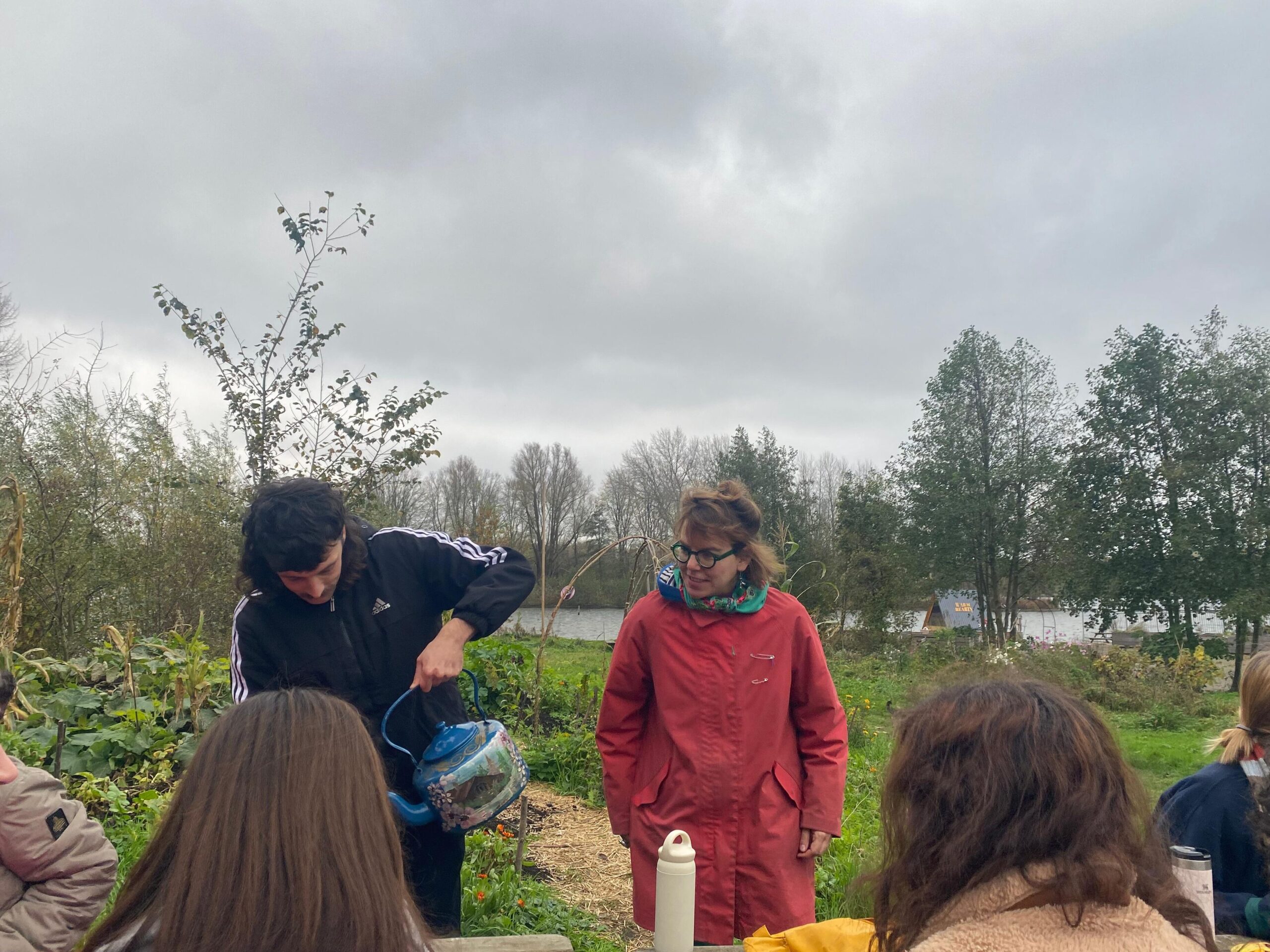
Serving tea, image by Ellie Gibbs
The Four Siblings project started as an experiment in inclusive and sustainable land art. Inspired by Agnes Denes’ Wheatfield (1982), the project initially took the shape of a corn maze, though has started taking on a more bottom-up, community-informed form over the years. They were struck by the idea of artists working directly with nature, instead of simply working with representations of it (pictures, paintings, etc.). In their work, soil or land is the artistic medium. Whereas Wheatfield was essentially a monoculture, Four Siblings chose a more sustainable polyculture approach. In addition, Four Siblings would serve as a community meeting place. In order to achieve this, the artists work on the basis of the Milpa system, a regenerative form of agriculture practiced by Indigenous peoples throughout Mesoamerica since time immemorial. This practice entails growing the ‘three sisters’ of corn, beans, and pumpkins together, where the corn provides a stalk for the beans to climb on while the pumpkins cover the soil, preventing the spread of weeds while avoiding loss of soil moisture. Four Siblings substituted the beans for the potato, added the sunflower as a ‘fourth sister’ to serve as a windscreen and draw in bees, and changed ‘sisters’ to ‘siblings’ to reflect the project’s inclusive aspirations. The artists attempt to work according to natural cycles, alternating years focused on gardening with years focused on rest and research, experimentation and arts.
During the first year of the project, a group of student journalists from a local primary school visited the project and wrote an article about it. These kinds of community exchanges are a key part of the project, which has hosted a range of (artistic) workshops, potlucks and talks since its inception, fostering community learning and exchanges of knowledge. Quite fittingly, the project is currently hosted at another community initiative. The Buurtwerkplaats Noorderhof, whose table saws occasionally harmonized with the neighbour’s leafblower as an accompaniment to our soft-spoken hosts, provided a haven when the project could no longer stay at the original plot of land that had been provided by the municipality. Perhaps unsurprisingly, the multifaceted nature of Four Siblings does not fit well into the rigid categories of municipal funding bureaucracy. This has led the initiators to come up with the term ‘precarious gardening’, a term that helps them reckon with a desire to do permaculture while acknowledging that permanent access to land is a privilege that they, like many others, do not have. “Rather than complaining about precarity, this allows us to embrace it”, in Müge’s own words.
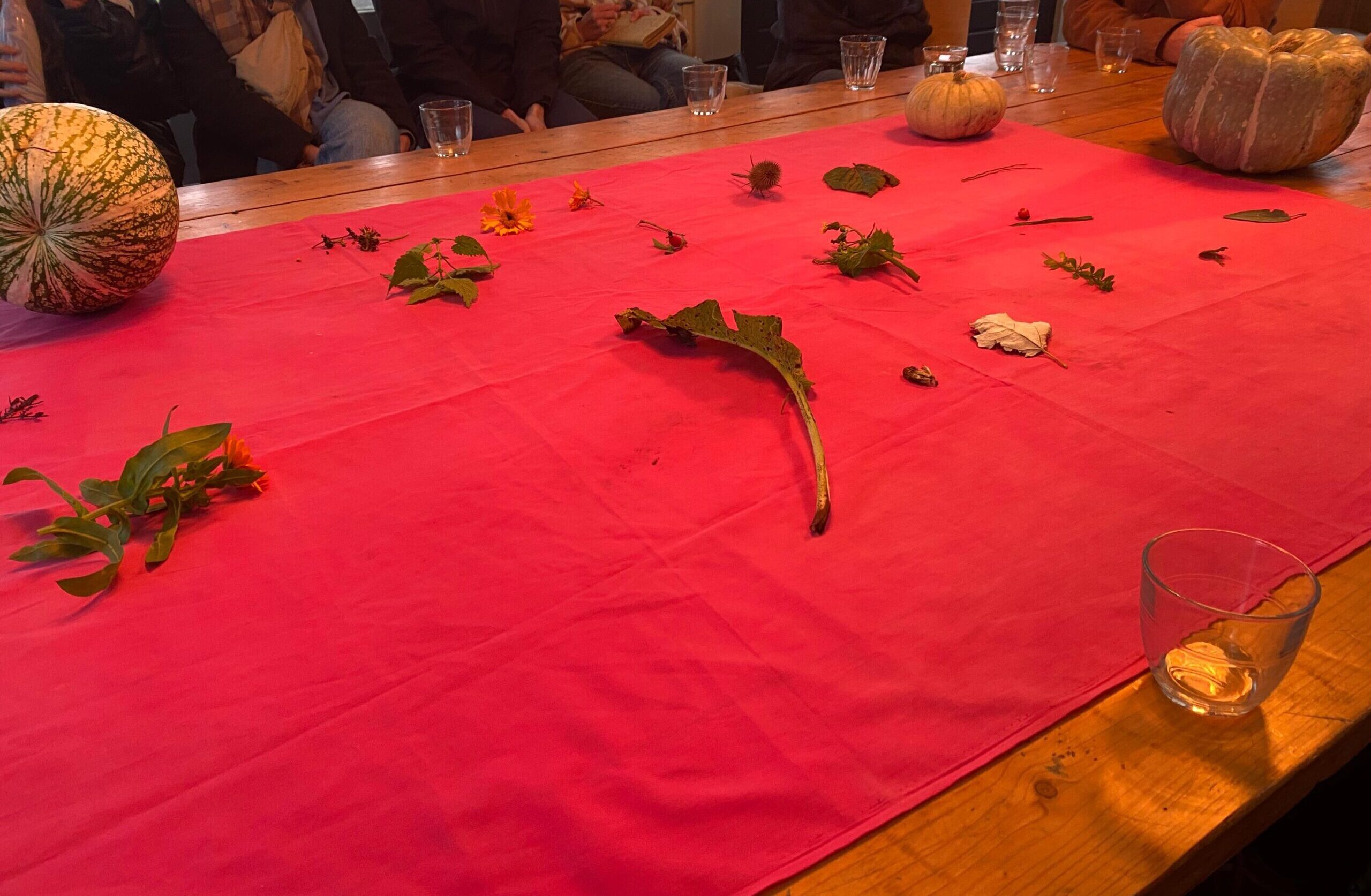
Plants picked by students, image by Ellie Gibbs
As an exercise in knowledge sharing, Müge and Emiel sent us into the garden to pick whatever plant appealed to us and bring it back inside. With all our finds laid out on a large pink tablecloth, we shared whatever knowledge or memories were attached to the plants we picked. What followed was a rich exchange that took us from the importance of grass to gardening through the culinary and medicinal properties of nettles to the application of horsetail as glaze for ceramics. Müge pointed out the connection between plant knowledge and medicine sovereignty, as knowledge about the natural healing properties of certain plants has increasingly become an object of scientific and corporate knowledge, instead of communal knowledge. It was an exercise befitting the nature of the project, rich in unexpected encounters (human and non-human alike) and learning together. Many thanks to Müge and Emiel for their hospitality, and for graciously sharing their time and knowledge.
By Jelmer Groenenboom and Veronica Rossi
Find Four Siblings here:
Website: https://foursistersproject.nl/
Instagram: four.siblings.collective
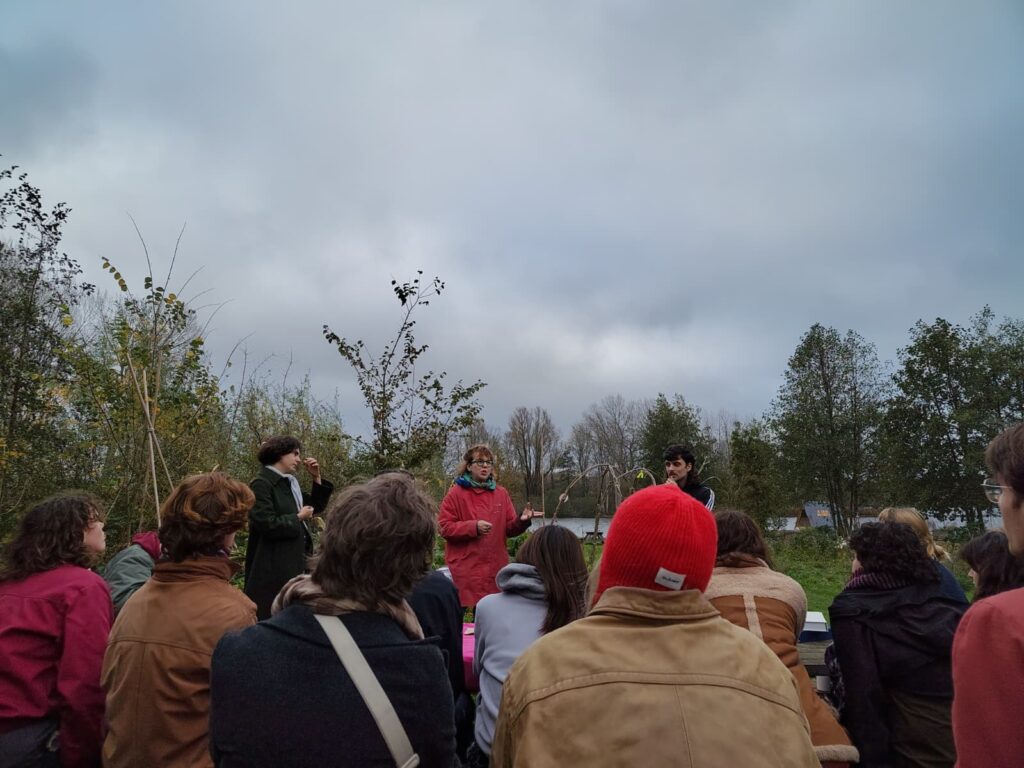
Visit at Four Siblings, image by Leyre Elizalde Araiz